_edited.png)
Why Your UKG Drums Don't Groove (And How to Fix It)
- Zen

- Apr 9
- 9 min read
The Real Reason Your UKG Drums Don't Groove
Modern UKG relies heavily on groove and swing, not just sound selection. You can have the right kick, the right snare, and the right tempo, and your drums will still feel robotic if the underlying timing is straight.
Straight timing means every hit falls exactly on the grid. Every 16th note is perfectly spaced. Mathematically correct, musically lifeless. Human drummers never play like this. Neither do the drum loops in the tracks you're trying to match.
The fix is swing. And the second fix is velocity. And the third is ghost notes. All three of these together are what gives UKG drums that bouncy, forward-pushing feel that makes a track work on a system.
Most producers who struggle with flat-sounding drums have one of three problems: swing applied at 0% (so it does nothing), all hits programmed at the same velocity (so nothing feels dynamic), or no ghost notes (so the groove has no texture between the main hits). This guide addresses all three.
How to Add Swing to UK Garage Drums
How do you add swing to UK garage drums? Set your DAW's swing to 16th note, between 63 and 67%, and make sure the global amount is at 100%. That last part is critical. A lot of producers apply swing and hear no difference because the global amount is sitting at 0%. The swing is technically applied but completely inactive.
In Ableton, go to the groove pool, load a 16th note swing groove, and set the global amount to 100%. For this style, 64% is a reliable starting point. The difference between 0% swing and 64% swing is the difference between a loop that sounds programmed and one that sounds like it was played.
Set your BPM to 134. This is the sweet spot for modern UKG. It's fast enough for the swing to feel bouncy and energetic, slow enough that the groove doesn't collapse under the weight of the kick.

The UKG Kick: Length Matters More Than You Think
The kick is where the groove starts. There was a traditional formula for UKG kicks, but listening to what producers like Interplanetary Criminal, MPH, and Silva Bumpa are doing now, the kick has shifted. Modern UKG kicks are shorter and dumpier than classic 4x4 kicks. Less sustain, more punch.
The key setting is length. If your kick is too long, it clashes with the bass and makes the low end feel congested rather than powerful. Shorten the kick until it hits and gets out of the way. You want the transient to land, the body to punch, and then space for the bass to breathe.
Two approaches work well together. A more traditional, punchy kick for tracks with a classic UKG feel. A shorter, more aggressive kick for modern 4x4 and speed garage influenced tracks. Both approaches can work in the same session depending on the energy you're going for.
Pitch is another tool most producers underuse. Don't treat the kick as fixed. If it feels too dull, pitch it up slightly. Too bright and clicky, pitch it down. The kick's pitch relationship with the bass root note affects how the low end locks together.

Snare, Rim, and the UK Garage Flavor
The snare is what gives a UKG loop its genre signature. A rim shot gives you a crisper, more percussive feel and pushes the track into a different territory. A real snare recording with heavy saturation, which is what producers like Bullet Tooth and Riordan use, gives you something rawer and more physical.
For a standard 909-based kit, the snare will sound vanilla out of the box. That's expected. Pitch it to fit. If the track is high energy and aggressive, pitch the snare up slightly for brightness. If you want something grungier, leave it or take it down. Small pitch changes make a big difference in how the snare sits against the kick and bass.
Switching from snare to rim completely changes the character of the loop. It's not just a different sound, it's a different groove feel. If your current pattern feels too straightforward, try swapping the snare for a rim and see how the rhythmic personality shifts.
Velocity Variation: The Detail That Separates Flat From Alive
What makes UKG drums sound bouncy? Velocity variation. When every hit in a pattern is programmed at the same volume, the loop sounds mechanical. Volume variation between hits is what the human brain reads as feel, as life, as something played rather than typed.
The simplest place to start: open hats in pairs. If you have two consecutive open hats, reduce the velocity of the first one slightly. The second hit then feels like a natural accent. That single change makes the hat pattern go from robotic to swung almost immediately.
Apply the same principle to tambourines and shakers. These percussion elements are texture layers, not accents. They should sit under the main kit, not compete with it. Program them with varying velocity across the pattern. Some hits quieter, some slightly louder. The tambourine should feel like it's moving with the groove, not stamping on it.
For a ping-pong delay on the tambourine, set it to 1/8 dotted and balance the track in place so the delay trails are always there at a consistent level. This adds width and movement to the percussion layer without cluttering the stereo image.

Ghost Notes: The Invisible Groove Tool
Ghost notes are drum hits placed at very low velocity in between your main drum hits. They're barely audible on their own. Most listeners won't consciously hear them. But they change the feel of the pattern significantly. What ghost notes do is fill in the rhythmic space between main hits. They give the loop a sense of continuous movement rather than just hit-pause-hit-pause. The groove feels denser, more human, and more forward-pushing, but without adding more prominent sounds. The key is placement and velocity. Place ghost notes where they feel natural rather than mechanical, typically in the spaces between main snare or kick hits where a drummer would naturally land a soft stroke. Keep the velocity low, somewhere between 20 and 40% of your main hit velocity. If they're too loud they stop being ghost notes and start competing with the main hits. On the kick, a ghost note double hit at low velocity in the second half of a bar creates a subtle forward push that makes the kick pattern feel more alive. On the snare, a ghost hit a 16th before the main snare lands creates a pull toward that hit that adds feel to the downbeat.

Percussion Layering: Adding Texture Without Clutter
Once the kick, snare, and hats are right, percussion layers are what give the groove texture and width. The options here are open hats, close hats, tambourines, shakers, and breakbeat slices.
The tambourine is particularly effective in UKG. It adds a high-frequency shimmer that glues the percussion layer together. Keep the velocity varied across the pattern and pitch it up if it feels too low and muddy. The tambourine should sit in the top of the mix, adding texture rather than weight.
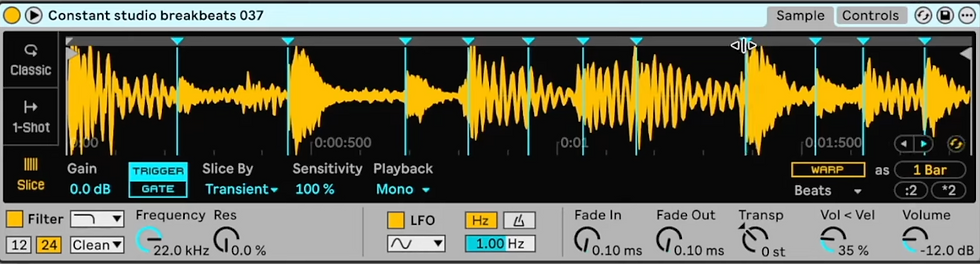
Breakbeat slices are the other option worth exploring. Chopping a break in Ableton's slice mode and using the Free Kilohertz plugin on the sliced output gives you a grittier, more textured feel that pairs well with electronic kicks and snares. The break adds organic imperfections that make the programmed kit feel less rigid. Layer it under your programmed kit rather than replacing it.
For any shaker or texture loop on the kick bus, keep the volume very low. It should be felt more than heard, just enough to add a little movement to the space around the kick transient.
Wide the open hat slightly. Adding a small delay to the right side of the stereo field, then checking in mono to confirm you're not losing too much signal, gives the hat a sense of space without pushing it out of the mix.
Drum Bus Processing: Gluing the Kit Together
Group all your drums to a single bus. This is where the kit starts to behave as one thing rather than a collection of separate hits.
Start with a glue compressor. Set the attack to 30 milliseconds so the initial transients of the kick and snare pass through before compression kicks in. Use a fast release so the compressor recovers quickly between hits. A ratio of 2:1 is enough. The goal is not heavy compression. You want the needle to dance, not clamp. The compressor should feel like it's tightening the kit, not squashing it.
From there, saturation is where the character comes in. Ableton's Roar, Saturator, or a hard clip all work. Roar has presets that add harmonic density to the drum bus that sits well in the mix. Start with the preset level and reduce the dry/wet until it's subtle. You can always add a second saturation stage after if you want more.
Optional but effective: a room reverb as a send from the drum bus. Keep it short, under 1 second, and at low level. It puts the drums in a shared space, which helps them feel like they came from the same room rather than separate samples. Don't send the kick too much through it.


Getting the Right Starting Point
Everything in this guide works on any drum sounds. But the sounds themselves do matter as a starting point. A kick that's already the right length and frequency range gets you to a working groove faster than one you need to reshape from scratch.
The grooves covered in this post are already dialed in inside Omen if you want a starting point. EvoSounds built Omen as a system for producers who want to work in UKG without spending the first hour of a session fighting drum sounds. The drum loops have the swing and feel already baked in. The individual samples are the right length and frequency character for the genre. You can still apply every technique in this guide on top of them. But you're starting from something that already works rather than something that needs fixing.
EvoSounds is known for building UKG tools that reflect how the genre is actually produced rather than how people assume it is. Omen was created specifically because sessions with artists kept revealing the same problems: the right sounds are hard to find, and even when you find them, the groove still requires this kind of detailed work to land correctly. That's the problem it was built to solve.
Frequently Asked Questions
How do I make my UKG drums groove?
Apply 16th note swing between 63 and 67% with the global swing amount at 100%. Add velocity variation across all drum hits so no two consecutive hits are the same volume. Include ghost notes at low velocity between your main kick and snare hits. These three changes together are responsible for most of the groove difference between a flat drum loop and one that feels alive.
What swing should I use for UK garage?
Use 16th note swing between 63 and 67%. 64% is a reliable starting point for most UKG styles. Make sure the global amount in your DAW is set to 100% or the swing will have no effect. In Ableton, this setting is in the groove pool.
What BPM is UKG?
UK garage typically runs between 130 and 138 BPM. Classic 2-step UKG sits around 130–132. Modern speed garage and 4x4 tracks push closer to 134–138. 134 BPM is a strong all-round choice for producing in this style.
Why do my drums sound robotic?
The most common cause is straight timing with no swing applied, or swing applied with the global amount at 0%. The second most common cause is uniform velocity across all hits. Every hit at the same volume removes all sense of dynamics and feel. Add swing, vary your velocities, and add ghost notes between main hits.
What makes UKG drums sound bouncy?
The bouncy feel in UKG drums comes from three things working together: 16th note swing at 63–67%, varied velocity across all hits so the pattern breathes naturally, and ghost notes that fill in the rhythmic space between main hits. Glue compression on the drum bus with a slow attack lets the transients punch through while tightening the overall kit feel.
What kicks are used in modern UKG?
Modern UKG has moved toward shorter, dumpier kicks with more punch and less sustain than traditional 4x4 kicks. Producers like Interplanetary Criminal, MPH, and Silva Bumpa use kicks that hit hard and get out of the way quickly, leaving space for the bass. Shorten the tail of your kick if it feels like it's cluttering the low end.
Final Thoughts
Flat UKG drums are almost always a timing and dynamics problem, not a sounds problem. Swing at 64%, varied velocity, ghost notes in the right places, and a drum bus with a glue compressor and light saturation. That's the formula.
The sounds matter too, and starting with the right kicks, snares, and percussion makes the process faster. But the technique in this post works regardless of what sounds you're using.
Apply it step by step on your next session and compare the result against where you started. The difference will be audible.


This is a great breakdown of why UKG drums can fall flat. I've been struggling with this, and your tips on swing and velocity are spot on. It's all about that subtle feel, and sometimes you just need a tool to help clean up your audio. If you're working with samples, I've found Demarker to be incredibly useful for removing unwanted artifacts.
Fans of winter racing games should definitely try Snow Rider 3D because of its engaging mechanics and endless replay value.
kart bros is a fun racing game that brings a thrilling competitive experience, with lots of interesting tracks and various obstacles. Players can change their strategy, acceleration, obstacle crossing placements to get high points and explore different ways of racing. Kart Bros is a fun and very competitive game so it’s great to play with friends since it encourages strategy and team effort.
The swing at 64 percent really brings the UKG drums to life. It's amazing how a small tweak can make such a big difference AI Couple Photo