_edited.png)
How to Make Sammy Virji Style Basslines: 4 UKG Bass Techniques
The Secret Is Simpler Than You Think
If you've ever listened to a Sammy Virji set and wondered why his low end just hits different, the answer isn't exotic hardware or some secret plugin chain. He's mostly building his basslines from sine waves and then doing very deliberate, very intentional things to them. FM modulation. Wave shaping. Layering. The 808 fundamentals.
It's not about what plugins you have. It's about understanding what each technique actually does to a sine wave and knowing when to reach for which one.
This post breaks down four core Sammy Virji bassline techniques you can build right now in Serum 2. These are the same approaches powering a lot of modern UKG production — and once you understand why each one works, you'll stop guessing and start making intentional decisions.
What You'll Learn
How to build an FM bassline from two sine waves and why FM ratio controls the character
How to use LFOs to animate your FM and waveshaped basses
How to layer multiple sine waves and use distortion to extract tone via waveshaping
How a band-pass filter transforms a harmonically busy source into a focused club bass
How to build Sammy's 808-style bass with envelope-modulated pitch
How ring mod flutter adds that tremolo-style UKG movement
When to use each technique based on the vibe you're going for
The Foundation: Why Sine Waves?
Before getting into the techniques, it helps to understand why sine waves are the starting point for all of them.
A sine wave is the cleanest waveform you can use. No harmonic content. No interference. It hasn't been polluted by overtones or complexity — it's pure. That purity is exactly why it reacts so predictably when you start doing things to it. FM modulation, distortion, and waveshaping all produce more controllable, musical results when you start from something clean.

Technique 1: FM Bassline
The Setup
Load up two oscillators in Serum 2:
Oscillator A — your main output signal. The tone you'll actually hear.
Oscillator B — your modulator. Set both to sine waves.
You can use either FM or Phase Distortion (PD) routing here. PD tends to be slightly easier to lock in — the character sits in a more predictable place and responds more intuitively when you're dialing the sound.
FM Ratio: The Most Important Knob
The FM ratio ( OSC B Octave) controls the relationship between oscillator B's frequency and oscillator A's. Think of it as the octave range for the modulator.
Push the ratio higher → the bass gets more aggressive and metallic. More energy in the upper harmonics. More bite.
Pull it down → the bass stays thicker and more focused in the low-mid.
That's your primary color control for this technique. Set it based on where the track needs to sit — thickness vs. aggression.
Animating It With an LFO

Routing an LFO to the FM amount is where this technique gets really interesting. The LFO takes the static FM character and turns it into something that moves — either:
A smack (fast attack, punchy movement)
A wub (slower, wobbling sweep)
Set the LFO's upper limit to control how far up the modulation sweeps. This gives you a bassline that changes character over the note sustain — which is a big part of why Sammy's low end feels so alive.

Distortion
Distortion is the most popular effect to add at the end of this chain. Add it — but be careful with the amount. Too much and you lose the composed, clean character that defines this style. You'll drift from Sammy's aesthetic into something more industrial and aggressive.
A moderate amount of saturation-style distortion adds presence and warmth without destroying the fundamental. That balance is everything.

Technique 2: Waveshaped Bass (Aggressive)
This one uses the same starting material — sine waves — but the approach is fundamentally different. Instead of FM modulation, you're going to layer multiple sine waves and use heavy distortion to shape the combined waveform into something entirely new.
Layering the Sines
Load three to four sine wave oscillators. In Serum 2, hold Alt and drag to copy oscillator settings quickly.
Drop all the levels down low to start you want to hear them mix together, not compete
Bring one up slightly as an anchor
The reason you use multiple sines rather than a more complex waveform is the same reason as before: individual sine waves are clean. When you layer them at different levels (and potentially at different harmonic intervals), the combined signal is still relatively controlled before you hit the distortion.
Distortion as the Shaping Tool

Apply heavy distortion before you dial in anything else. Here's the key insight: the distortion is the instrument. It's transforming the layered sine content into a new tonal character.
Here's where it gets interesting: as you bring the level of individual oscillators up or down, the tone changes. The distortion is reacting to the balance of the layered content. Start with distortion active and adjust the oscillator balance while listening to how it shapes the sound.
LFO Movement
Same principle as Technique 1. Route an LFO to move a relevant parameter level, distortion amount, or filter cutoff— and it smooths out the character and adds life. Pull the level of one oscillator down and blend the LFO modulation in for a more fluid, evolving texture.

Harmonic Intervals (Advanced)
This is a more advanced detail worth knowing: tune your additional sine oscillators to harmonic intervals rather than just unison or octaves. Think of the intervals you'd hear in a chord on a piano — thirds, fifths.
Those harmonic relationships between the oscillators affect how the distortion responds and what overtones get emphasized. It will change the character in ways you have to hear. Try a few and trust your ears.

Technique 3: Band-Pass Filtered Bass
The first two techniques lean on sine waves because of their cleanliness. This one starts from something moreharmonically complex — and then focuses it down.
Why It's Different
A band-pass filter cuts both the low frequencies below its center point and the high frequencies above it, leaving only a focused band of mid frequencies. When you apply that to a busy, harmonically rich source, you're extracting a specific character from within that complexity — which is a very different sound from building up from a sine.
The Setup
Step 1: Start with a square wave oscillator. A square wave has a lot of harmonic content — it's the opposite of a sine. That complexity is what you're going to work with.
Step 2: Apply a band-pass filter. Find the center frequency where it sounds most focused and interesting. Increase the resonance to give the filtered band more emphasis and personality.
Step 3: Route the sub-frequency content (below the band-pass region) directly out of the effects chain. Your sub stays clean and unprocessed. The mid content goes through the band-pass character. This split routing is the secret to keeping the low end tight.
Step 4: Add drive to the filtered signal.
Step 5: Adjust the level blend between the filtered signal and the clean sub. That balance is where you tune the final character of this bassline.

Technique 4: 808-Style Bass
This is the most widely used Sammy Virji bass technique and the one you'll hear across a lot of his tracks. Deceptively simple to build — but the details matter.
Envelope-Modulated Pitch
Start with a sine wave. Add a unipolar envelope routed to the coarse pitch.
A unipolar envelope only moves in one direction. In this case, it creates a downward pitch drop from a higher point to the fundamental — that's the "knock" or thump you hear at the attack of the note.
The two key controls:
Sustain: Pull it all the way down.
Decay: This is your main control for how the knock develops. A shorter decay = tighter, punchier knock. A longer decay = classic 808 pitch glide.
Distortion + Filter
Route a significant amount of distortion to the sine. Same rule applies: don't overdistort. You want saturation and presence — not destruction of the fundamental.
Use a low-pass filter to roll off some of the top end that the distortion introduces. This keeps the 808 focused and full, not harsh.
Release and Mono Legato
For that classic 808 feel, add a small amount of release. Then set the voice mode to mono legato.
Mono legato means notes slide into each other when played overlapping — exactly the portamento behavior you hear in 808 basslines. Notes connect rather than retrigger. That sliding quality is what gives the bass its melodic, flowing movement.
Bonus: Ring Mod Flutter
This is a finishing technique — something you stack on top of any of the four basslines above, not a standalone approach.
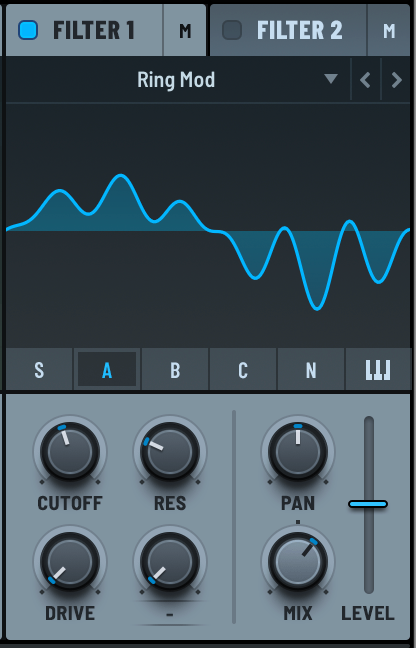
Go into the effects section of any bass patch and add a ring modulator. In Serum 2, find it under Misc > Ring Mod.
At low values, ring mod produces something that sounds close to a tremolo — a rhythmic volume fluctuation, rather than the aggressive metallic clang you'd get at higher settings. This UKG flutter adds movement and texture on top of whatever bassline you've built. It's subtle, it's club-friendly, and it's the kind of detail that makes a static bass feel alive in a mix.
FAQ
What synthesizer does Sammy Virji use for his basslines?
Sammy Virji's style is closely associated with Serum, and the techniques described here — FM modulation, phase distortion, sine wave layering — translate directly into Serum 2. Most modern UKG producers use Serum as their primary soft synth for bass sound design.
What is FM bass in UKG production?
FM bass uses one oscillator (the modulator) to modulate the pitch or phase of a second oscillator (the carrier). In UKG, this creates complex harmonic movement from a very simple starting point — two sine waves. The FM ratio controls how aggressive or thick the character is, and LFO modulation of the FM amount creates the animated, moving quality you hear in Sammy Virji-style basses.
Why do UKG producers use sine waves for bass?
Sine waves have no harmonic content of their own. That purity means when you apply FM modulation, distortion, or waveshaping to them, the results are controllable and musical.Starting with a more complex waveform makes the distortion harder to predict and the tone harder to dial in.
What is waveshaping in bass synthesis?
Waveshaping uses distortion as a tone-shaping tool rather than just a saturation effect. By layering multiple sine oscillators at different levels and running them through heavy distortion, you're using the nonlinear response of the distortion to create new harmonic content from the combined signal. Adjusting the oscillator balance changes how the distortion responds and what the final tone sounds like.
What is the 808 bass technique in UKG?
The 808 technique uses a unipolar envelope modulating the coarse pitch of a sine wave to create a downward pitch knock at the attack of each note. Sustain is set to zero, and the decay controls how long the pitch glide takes. Distortion, a low-pass filter, and mono legato voice mode complete the sound. It's the same foundational technique as hip-hop 808s — applied in the context of UKG groove and tempo.
What is ring mod flutter in UKG bass?
Ring mod flutter refers to using a ring modulator at a very low rate or depthso that instead of the classic metallic ring mod effect, it produces a fast tremolo-like volume flutter. Applied subtly on top of a finished bass patch, it adds rhythmic movement and a club-ready, alive quality.
How do I make my UKG basslines sound more like Sammy Virji?
Focus on three things: start with clean sine waves, use LFOs to animate your key parameters rather than leaving basses static, and be conservative with distortion. Sammy's aesthetic is composed and musical, not aggressive or industrial. The movement comes from automation and modulation — not from extreme processing.
What is a band-pass filtered bass?
A band-pass filter isolates a specific frequency range, cutting everything above and below a center point. When applied to a harmonically rich source like a square wave, it extracts a focused, mid-heavy character. In UKG, this technique creates basses with a different texture than pure sine-based approaches — with the sub routed separately to keep the low end clean.
Get the Sounds
If you want Serum 2 presets built on these exact techniques — FM basses, waveshaped subs, 808s, and UKG-focused sound design — check out Omen by EvoSounds. It's a UKG and speed garage hybrid pack built to bridge the gap between classic UK bass sounds and modern underground club production.
The presets give you the foundation so you can spend your session shaping and arranging — not starting from zero every time.
Conclusion
The reason Sammy Virji's basslines work isn't because of one secret technique. It's because he understands what each tool is actually doing and uses it with intention.
FM modulation for harmonic movement
Waveshaping for aggressive, evolving texture
Band-pass filtering for a different tonal character
The 808 for melodic, pitching low end
LFOs on everything to keep it alive
Learn these four approaches well enough that you're choosing between them based on what a track needs — not just reaching for whichever one you built last time.
That's the actual skill.
And once your basses are dialed in, the next thing to work on is how they sit in the groove. Start with Why Your UKG Drums Don't Groove And How to Fix It — because even the best bass in the world sounds flat behind the wrong drum pattern.
Next Step
You now know the four bassline frameworks behind modern UKG production. The next thing to stack on top of these is groove — understanding how UKG drums and swing quantization interact with a bassline like this. Start with Why Your UKG Drums Don't Groove And How to Fix It.


mình có lần lướt đọc mấy trao đổi trên mạng شيخ روحاني thì thấy nhắc nên cũng tò mò mở ra xem thử cho biết. mình không tìm hiểu sâu chỉ xem qua trong thời gian ngắn để quan sát bố cục cách sắp xếp جلب الحبيب các mục và trình bày nội جلب الحبيب dung tổng thể. cảm giác là các phần được trình bày khá gọn, các hurentest berlin mục rõ ràng Huren Berlin nên đọc lướt cũng không bị rối với mình như vậy là đủ để nắm tin cơ bản rồi. جلب الحبيب
👍
Gracias por compartir este contenido tan interesante. La explicación resulta fácil de seguir y aporta información que puede ser útil para muchos lectores. Si alguien desea ampliar la información relacionada con la lotería nacional, también puede consultar diferentes resultados y datos en un solo lugar.
The bit about FM modulation being the secret sauce makes so much sense now—I always wondered how he gets that gritty, almost vocal-like movement in the low end. Definitely gonna try the wave shaping trick on my next 808 session, I've been using https://perchance-ai-image.com
The bit about FM modulation being the secret sauce really clicked for me—I’ve been layering sine waves for weeks without that intentional wave shaping step. Definitely trying the 808 fundamentals trick on my next session, and I’ve been using https://muse-video.pro
The bit about FM modulation being the secret sauce finally clicked for me—I’d been overcomplicating the wave shaping. Definitely trying the layering trick on my next 808 pass, I've been using https://ai-logo-generator.com